


When I open a new client’s Meta ad account, the first thing I usually see is chaos: fifteen campaigns, dozens of ad sets with tiny budgets, the same audience targeted five times, and nobody sure which ads are making money. More campaigns do not mean more sales. In 2026, the accounts that grow fastest usually have the simplest Facebook Ads campaign structure.
Here is the structure I use for most e-commerce and service businesses, why it works with how Meta’s delivery system learns today, and how to adapt it to a small budget.
Quick Answer
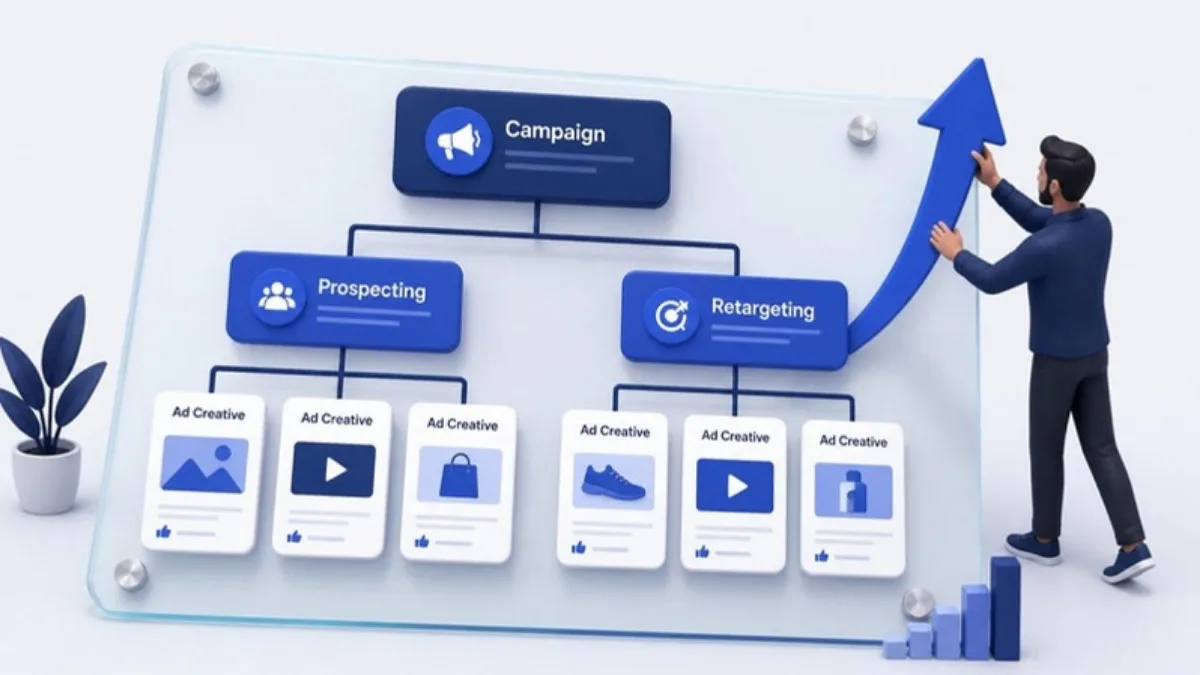
A strong Facebook Ads campaign structure uses very few campaigns: one for testing new creatives, one for scaling proven winners, and one small retargeting campaign if your traffic is large enough. Fewer, better-funded ad sets give Meta more data per ad set, which helps them exit the learning phase and keeps cost per result stable.
- Testing campaign: finds new winning creatives.
- Scaling campaign: puts most of the budget behind proven ads.
- Retargeting: only if you have enough site visitors and engagers.
- Use broad targeting and let creatives do the targeting.
- Avoid many small ad sets that never get enough conversions.
Why Simple Structures Win Now
Meta’s delivery system learns from conversions. Every ad set needs enough results to stabilize, and Meta has long said ad sets typically need around 50 optimization events in a week to exit the learning phase. If you split a small budget into ten ad sets, none of them gets there, so all of them stay unstable and expensive.
At the same time, targeting has become broader. Interest targeting matters less than it used to, while the creative itself, the hook, the offer and the visual, now decides who sees your ad. That means your structure should be built around testing creatives, not around slicing audiences.
The 3-Campaign Structure
| Campaign | Purpose | Budget share |
|---|---|---|
| Testing | Test new creatives and angles | About 20 to 30% |
| Scaling | Run proven winners with broad targeting | About 60 to 70% |
| Retargeting | Bring back visitors and cart abandoners | About 10%, only with enough traffic |
1. Testing campaign
Use one ad set with broad targeting and add three to five new creatives at a time. Give each batch a few days and judge them on cost per purchase or cost per lead, not just clicks. The goal of this campaign is not profit. It is to find the next winner.
2. Scaling campaign
Move the winners from testing into the scaling campaign. Here you can use Advantage+ Sales or a broad manual campaign with campaign budget. Increase budget gradually, around 15 to 20% every few days, so you do not throw the campaign back into learning.
3. Retargeting campaign
If your site gets steady traffic, a small retargeting campaign for product viewers and cart abandoners works well, especially with offers or reviews in the creative. For small stores, you can skip it, because broad campaigns already show ads to warm users.
Structure for Small Budgets in Bangladesh
If you spend less than a few thousand taka per day, run one campaign with one ad set and three to four ads. Optimize for purchases if you get several orders per day. If you get fewer, optimize for Add to Cart or Initiate Checkout until volume grows. Many Bangladeshi f-commerce pages also run Messenger or WhatsApp campaigns, and the same rule applies there: fewer ad sets, more budget each.
Tracking Comes First
None of this works if Meta cannot see your sales. Before restructuring, make sure your Pixel and Meta Conversion API are sending purchase events with value and currency. My guide on Meta Conversion API explains why browser-only tracking misses sales.
Mistakes I See Every Week
- Too many ad sets with tiny budgets.
- Duplicating the same audience in several campaigns so they compete with each other.
- Turning off ads after one day.
- Changing budgets by 100% overnight.
- Judging creatives on CTR alone instead of cost per result.
Facebook Ads Campaign Structure FAQ
How many campaigns should I run on Facebook Ads?
Most businesses only need two or three: a testing campaign, a scaling campaign, and an optional retargeting campaign.
How many ads should be in one ad set?
Three to five is a good range. Enough to test different angles, few enough that each ad gets meaningful spend.
Should I use interest targeting or broad targeting?
For most accounts in 2026, broad targeting with strong creatives performs as well as or better than narrow interests, especially once your Pixel has enough data.
How fast can I increase my Facebook Ads budget?
Increase it gradually, about 15 to 20% every few days, to avoid restarting the learning phase.
What is the best structure for a small budget?
One campaign, one ad set, three to four creatives, optimizing for the deepest event you can reach consistently.
Final Thoughts
A clean Facebook Ads campaign structure is not about clever tricks. It is about giving Meta enough data per ad set and spending your energy on better creatives. Keep it simple, test consistently and scale slowly. If you also run TikTok, the same idea applies there, as I explain in the TikTok Ads learning phase guide.
Official Resources
Need help with Facebook Ads campaign structure?
I am Rubel Hasan Rokib, a data-driven digital marketer based in Bangladesh. Send me your website or ad account details on WhatsApp and I will reply with a clear plan.







3 Comments