

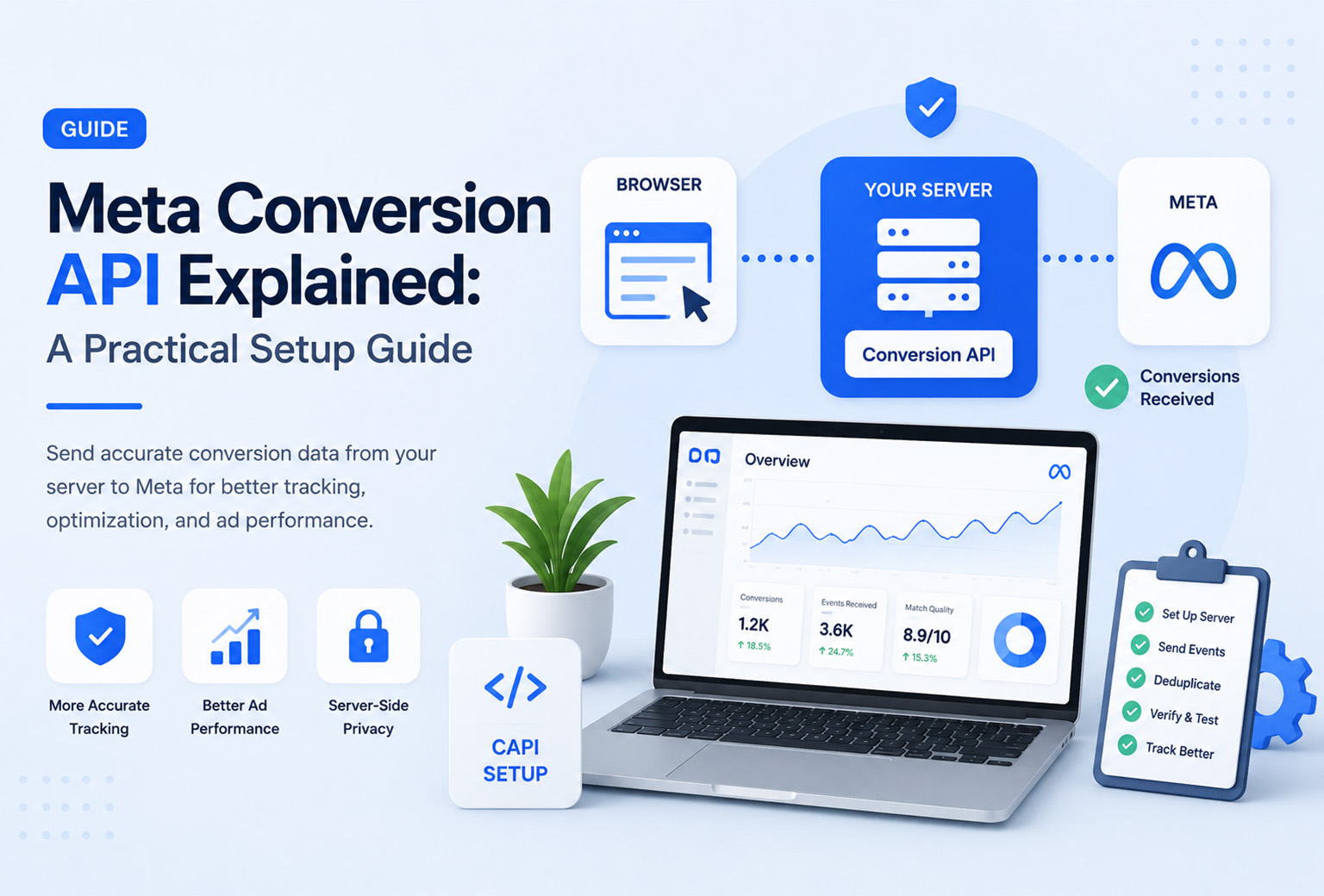
Meta advertising has evolved significantly over the past few years. With growing privacy regulations, browser restrictions, and cookie limitations, traditional browser based tracking is no longer enough for businesses that rely on Facebook and Instagram ads.
This is where the Meta Conversion API (CAPI) comes in. It helps businesses send conversion data directly from their server to Meta, resulting in more reliable tracking, better attribution, and improved campaign performance.
In this guide, you’ll learn what Meta Conversion API is, how it works, why it matters, and how to set it up correctly.
In This Guide
- What Is Meta Conversion API?
- Why Meta Created Conversion API
- How Meta Conversion API Works
- Meta Pixel vs Meta Conversion API
- Benefits of Meta Conversion API
- What You Need Before Setup
- Popular Ways to Implement Meta Conversion API
- Recommended Event Structure
- Event Deduplication Explained
- Best Practices
- Common Mistakes
- How to Test Your Setup
- Final Thoughts
What Is Meta Conversion API?
Meta Conversion API (CAPI) is a server side tracking solution developed by Meta that allows your website or application to send customer events directly to Meta’s servers.
Unlike the Meta Pixel, which relies on the visitor’s browser, CAPI sends events from your server. This makes tracking more accurate even when browsers block cookies or users enable privacy features.
Common events include:
- PageView
- ViewContent
- AddToCart
- InitiateCheckout
- AddPaymentInfo
- Purchase
- Lead
- CompleteRegistration
Why Meta Created Conversion API
Modern browsers and operating systems are becoming more privacy focused.
Challenges include:
- Third party cookie restrictions
- iOS privacy updates
- Ad blockers
- Browser tracking prevention
- Cookie expiration
These changes often cause Meta Pixel to miss important events.
Conversion API helps recover lost conversion data by sending events directly from your server.
How Meta Conversion API Works
The process is straightforward.
- A visitor performs an action on your website.
- Your server receives the event.
- The server securely sends the event to Meta.
- Meta matches the event with the user.
- Ads Manager records the conversion.
Instead of relying only on the browser, the server provides another trusted source of data.

Meta Pixel vs Meta Conversion API
| Meta Pixel | Meta Conversion API |
|---|---|
| Browser based | Server based |
| Can be blocked | More reliable |
| Depends on cookies | Less dependent on cookies |
| May lose events | Better event accuracy |
| Easier setup | Requires server configuration |
| Limited by browser privacy | Works around many browser limitations |
The best practice is using both Meta Pixel and Conversion API together.
Benefits of Meta Conversion API
Better Event Tracking
Server side tracking reduces missing conversions caused by browser restrictions.
Improved Event Match Quality
Meta can better identify users using customer information such as:
- Phone number
- First name
- Last name
- City
- Country
- ZIP code
All sensitive information should be securely hashed before transmission.
Higher Event Match Quality often leads to stronger optimization.
Better Campaign Optimization
Meta’s machine learning receives more complete conversion data, allowing it to optimize campaigns more effectively.
This can improve:
- Cost Per Purchase
- Return on Ad Spend (ROAS)
- Cost Per Lead
- Conversion Rate
More Accurate Attribution
When browser tracking fails, server events help preserve conversion attribution.
This provides more accurate reporting inside Meta Ads Manager.
Future Proof Tracking
As privacy regulations continue to evolve, server side tracking is becoming the industry standard.
Implementing CAPI today prepares your business for future tracking changes.
What You Need Before Setup
Before implementing Meta Conversion API, make sure you have:
- Meta Business Manager
- Meta Pixel
- Website access
- Google Tag Manager (recommended)
- Google Analytics 4
- Server side GTM (optional but recommended)
- Domain Verification
- Aggregated Event Measurement configured
Popular Ways to Implement Meta Conversion API
1. Partner Integration
Ideal for:
- Shopify
- WooCommerce
- WordPress
- Magento
- BigCommerce
Many platforms offer built in integrations.
2. Google Tag Manager Server Side
A flexible solution that provides greater control over tracking.
Recommended for agencies and advanced marketers.
3. Direct API Integration
Developers can send events directly using Meta’s API.
Best suited for custom websites and applications.
Recommended Event Structure
A typical Purchase event includes:
- Event Name
- Event ID
- Event Time
- Currency
- Value
- Content IDs
- Content Type
- User Data
- Action Source
Using consistent Event IDs helps Meta deduplicate browser and server events.
Event Deduplication Explained
When using both Meta Pixel and Conversion API, the same conversion may be sent twice.
Meta compares the Event ID from both sources.
If they match, Meta counts only one conversion.
This process is called Event Deduplication and is essential for accurate reporting.
Best Practices
To maximize performance:
- Use both Pixel and Conversion API.
- Enable Event Deduplication.
- Send high quality customer data securely.
- Verify your domain.
- Test using Meta Events Manager.
- Monitor Event Match Quality.
- Validate every important event.
- Keep event names consistent.
Common Mistakes
Avoid these issues:
- Missing Event ID
- Duplicate Purchase events
- Incorrect event names
- Missing value or currency
- Incomplete customer information
- Testing only in production
- Ignoring Event Match Quality
How to Test Your Setup
Use Meta Events Manager to verify:
- Test Events
- Event Diagnostics
- Event Match Quality
- Deduplication Status
- Server Event Receipt
Fix any warnings before launching campaigns.
Final Thoughts
Meta Conversion API has become an essential component of modern digital marketing. As browser based tracking becomes less reliable, server side tracking helps businesses maintain accurate conversion data, improve campaign optimization, and achieve stronger advertising results.
For the best performance, use Meta Pixel and Meta Conversion API together. This combination provides more complete data, better attribution, and a stronger foundation for optimizing your Facebook and Instagram advertising campaigns.
Whether you’re an eCommerce store owner, marketer, or analytics professional, implementing Meta Conversion API is a smart investment for long term advertising success.
Official Resources
Need help with Meta Conversion API?
I am Rubel Hasan Rokib, a data-driven digital marketer based in Bangladesh. Send me your website or ad account details on WhatsApp and I will reply with a clear plan.






2 Comments