


What if you could connect your TikTok Ads account directly to Claude, give Claude your advertising goals, and let AI analyze your existing campaign data before creating a new campaign?
That is exactly what I demonstrated in this video.
Instead of manually checking every campaign, ad group, creative, audience, and performance metric inside TikTok Ads Manager, I connected Claude with the official TikTok for Business MCP Server.
Then I provided Claude with my TikTok Ads account information, including the relevant advertiser account ID and account name.
After that, I instructed Claude to analyze my existing TikTok Ads data, identify the best-performing videos and audiences, research the available data, and create a new campaign based on the findings.
The interesting part is that I specifically instructed Claude not to turn off my existing campaign and to create the new campaign in a way that minimizes unnecessary competition with the existing campaign.
This is where AI-powered TikTok Ads automation becomes extremely interesting.
In This Guide
- Watch the Full TikTok Ads Automation Tutorial
- What Is TikTok Ads MCP?
- Why Connect TikTok Ads to Claude?
- What Do You Need to Connect TikTok Ads to Claude?
- Step 1: Connect Claude to TikTok Using the Official MCP Server
- Step 2: Select the Correct TikTok Ads Account
- Step 3: Ask Claude to Analyze Existing TikTok Ads Data
- Finding the Best-Performing TikTok Videos
- Identifying the Right Audience for Each Video
- AI-Powered Creative Analysis
- Step 4: Give Claude a Detailed Campaign Creation Prompt
- Step 5: Claude Researches the Existing Performance Data
- Step 6: Claude Creates a New TikTok Ads Campaign
- Keeping the Existing Campaign Running
- Avoiding Unnecessary Campaign Competition
- The Complete TikTok Ads AI Automation Workflow
- Why This TikTok Ads Automation Workflow Is Powerful
- AI Does Not Replace a Performance Marketer
- The Future of TikTok Ads Management
- Final Thoughts
- Frequently Asked Questions
Watch the Full TikTok Ads Automation Tutorial
In this tutorial, I show the complete workflow of connecting TikTok Ads with Claude and using the official MCP Server to analyze advertising data and create a new TikTok Ads campaign.
What Is TikTok Ads MCP?
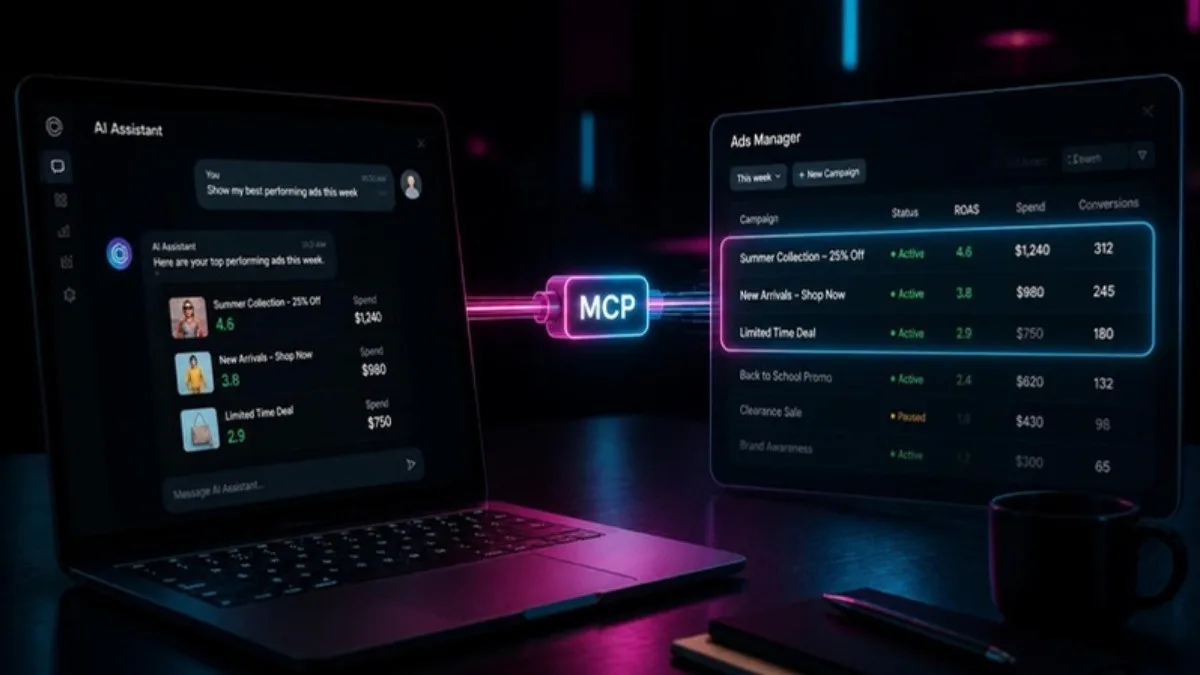
MCP stands for Model Context Protocol.
In simple terms, MCP allows an AI assistant to communicate with external tools and platforms in a structured way.
The TikTok for Business MCP Server allows compatible AI agents to interact with TikTok’s advertising ecosystem and perform advertising-related tasks.
TikTok’s official documentation describes its MCP Server as a standardized bridge that can expose core advertising functions including campaign management, performance reporting, audience configuration, and creative operations to AI agents.
Official TikTok for Business MCP Server
For this workflow, I used the official TikTok for Business MCP Server.
If you are using Claude, TikTok currently recommends its Full Disclosure MCP Server:
Official TikTok for Business MCP Server for Claude
TikTok also provides a Progressive Disclosure server for setups where a smaller initial tool library is preferred:
TikTok for Business Progressive Disclosure MCP Server
TikTok’s official documentation currently recommends the Full Disclosure server for Claude.
You can also read the official documentation here:
Official TikTok for Business MCP Server Documentation
Why Connect TikTok Ads to Claude?
Traditional TikTok Ads management often requires a marketer to manually perform several steps.
You may need to:
- Open TikTok Ads Manager
- Check campaign performance
- Review ad group performance
- Analyze creative performance
- Compare conversion data
- Review audience performance
- Identify winning videos
- Research targeting opportunities
- Create a campaign
- Configure targeting
- Select creatives
- Set budgets
- Launch the campaign
- Monitor the results
This can take a significant amount of time.
With Claude + TikTok Ads MCP, many of these data-heavy and repetitive processes can be handled through an AI-powered workflow.
Instead of manually moving data between different tools, you can provide Claude with your objective and let it work with the connected TikTok Ads environment.
If you are new to TikTok advertising, you can also read our detailed guide on TikTok Ads in Bangladesh, which covers TikTok Business Center, Ads Manager, campaign structure, Pixel, tracking, conversion events, and ecommerce advertising.
What Do You Need to Connect TikTok Ads to Claude?
Before starting this workflow, you need a few things.
1. TikTok Ads Account
You need an active TikTok advertising account with the appropriate permissions.
This is the account where your campaigns, ad groups, creatives, audiences, and performance data are stored.
2. Claude
You need access to Claude to use the AI assistant in this workflow.
Claude acts as the AI layer that understands your instructions, analyzes available information, and interacts with the connected MCP tools.
3. Official TikTok for Business MCP Server
The most important component is the official TikTok for Business MCP Server.
This creates the connection between the AI assistant and TikTok’s advertising environment.
Using the official MCP Server is important because you are working with TikTok’s own advertising infrastructure rather than relying on an unofficial third-party automation layer.
4. TikTok Ads Account ID
You should know the TikTok Advertiser Account ID that you want Claude to work with.
In my workflow, I specifically provided the relevant ad account ID to Claude so that it could work with the correct advertising account.
5. Connected TikTok Account
Your TikTok account should already be properly connected to the relevant advertising environment.
Having the required account connections and permissions in place makes the workflow much easier to manage.
Step 1: Connect Claude to TikTok Using the Official MCP Server
The first step is connecting Claude with the TikTok for Business Official MCP Server.
Once the MCP connection is configured, you need to complete the required authorization process.
After successful authorization, Claude can discover and use the TikTok advertising capabilities made available through the MCP connection.
This is the point where the workflow becomes much more powerful than a normal AI conversation.
Claude is no longer simply answering questions about TikTok Ads.
It can work with connected advertising tools and data.
Step 2: Select the Correct TikTok Ads Account
After connecting the MCP Server, I provided Claude with the information required to identify my advertising account.
I gave it:
- My TikTok Ads Account ID
- My account name
- The relevant TikTok account information
- Instructions about which advertising account to analyze
This is an important step.
If you manage multiple TikTok Ads accounts, you need to make it extremely clear which advertiser account Claude should use.
The more precise your instructions are, the easier it is for the AI to understand the advertising environment it needs to work with.
Step 3: Ask Claude to Analyze Existing TikTok Ads Data
This is where things become really interesting.
Instead of immediately asking Claude to create a campaign, I first instructed it to analyze my existing TikTok Ads data.
The goal was to understand what was already working.
A good AI advertising workflow should not start with:
“Create me a campaign.”
It should start with:
“Understand my existing data first.”
That allows the AI to use historical performance information before making new campaign decisions.
If you want to understand the fundamentals of TikTok campaign structure, targeting, Pixel, conversion events, and campaign optimization, our complete TikTok Ads setup guide is a useful starting point.
Finding the Best-Performing TikTok Videos
One of the most important parts of the analysis was identifying which videos were generating the strongest results.
Not every TikTok video performs equally.
One creative may generate a high number of views.
Another may generate more clicks.
Another may produce significantly better conversions.
For performance marketing, views alone are not enough.
You need to understand the relationship between:
Ad Spend → Impressions → Clicks → Conversions → CPA → ROAS
The objective is not simply to find the most popular video.
The objective is to identify the creatives that have the strongest potential from a conversion and business performance perspective.
Identifying the Right Audience for Each Video
Another important part of the analysis was audience performance.
Different creatives can perform differently across different audience segments.
A video that performs extremely well with one age group may not necessarily produce the same results with another audience.
This is why audience analysis is an important part of TikTok Ads optimization.
By analyzing historical performance, AI can help identify patterns such as:
- Which age groups respond better to specific creatives
- Which audiences generate more conversions
- Which creatives are stronger for specific audience segments
- Which targeting strategies may be worth testing
This makes campaign creation much more data-driven.
AI-Powered Creative Analysis
Creative performance is one of the most important factors in TikTok advertising.
TikTok is a creative-first platform.
The right audience with the wrong creative can still produce poor results.
That is why I wanted Claude to analyze the existing creative performance before creating a new campaign.
The objective was to answer a simple question:
Which videos are actually producing business results?
Once the winning creatives are identified, they can become part of the strategy for the next campaign.
Step 4: Give Claude a Detailed Campaign Creation Prompt
After analyzing the existing data, I gave Claude a detailed instruction for creating a new campaign.
This is another critical part of the workflow.
AI performance depends heavily on the quality of the instructions you provide.
Instead of simply saying:
“Create a TikTok Ads campaign.”
I gave Claude a much more detailed objective.
The instruction included requirements such as:
- Analyze the existing account data
- Identify high-performing creatives
- Understand audience performance
- Consider conversion performance
- Research the available data
- Create an attractive new campaign
- Do not turn off the existing campaign
- Avoid unnecessary audience conflict
- Use the available data to make campaign decisions
This gave Claude a clear framework for the campaign creation process.
Step 5: Claude Researches the Existing Performance Data
Once the instruction was provided, Claude started working through the available data.
The goal was not to randomly create another campaign.
Instead, it used the available advertising information to understand what had already worked.
This is an important difference between AI automation and simple campaign generation.
AI should not just create something new.
It should learn from what has already happened.
Step 6: Claude Creates a New TikTok Ads Campaign
After analyzing the data, Claude used the available TikTok advertising tools through MCP to create a new campaign according to the instructions.
The campaign strategy was based on the available performance information.
This means the workflow became:
Existing Data → Analysis → Research → Strategy → Campaign Creation
rather than:
Random Idea → Campaign Creation
That is a much more intelligent approach to AI-powered advertising.
Keeping the Existing Campaign Running
One of my most important instructions was that the existing campaign should remain active.
I did not want the AI to simply shut down the previous campaign and replace it with a new one.
The objective was to create an additional campaign while keeping the existing campaign active.
This is particularly important when you already have a campaign generating conversions.
You generally do not want an automation system to make major changes to an active campaign without understanding the potential impact.
Avoiding Unnecessary Campaign Competition
I also instructed Claude to consider potential conflicts between the new and existing campaigns.
The objective was to avoid creating unnecessary competition between campaigns targeting essentially the same audience with similar structures.
Of course, no AI system can guarantee that two campaigns will never compete in an auction.
TikTok’s auction system, audience availability, budget, optimization settings, and targeting configuration can all influence delivery.
However, providing this requirement to the AI gives it an important constraint when developing the new campaign strategy.
The Complete TikTok Ads AI Automation Workflow
The complete process can be summarized like this:
Step 1: Connect Claude to the official TikTok for Business MCP Server.
Step 2: Authorize the TikTok advertising account.
Step 3: Provide the correct TikTok Ads Account ID.
Step 4: Provide the account name and relevant account context.
Step 5: Ask Claude to analyze existing TikTok Ads performance.
Step 6: Identify high-performing videos and creatives.
Step 7: Analyze audience and age-group performance.
Step 8: Identify conversion-focused creatives.
Step 9: Research the existing campaign structure.
Step 10: Provide Claude with a detailed campaign creation prompt.
Step 11: Ask Claude to create a new campaign without turning off the existing campaign.
Step 12: Ask it to minimize unnecessary audience overlap and campaign conflict.
Step 13: Review the campaign before scaling the budget.
Why This TikTok Ads Automation Workflow Is Powerful
The real value of this setup is not simply that AI can create a campaign.
The real value is the combination of:
AI + First-Party Advertising Data + MCP + Automation
Claude can understand your instructions.
MCP provides access to the connected advertising tools.
TikTok provides the advertising data.
The AI can then use that information to help make data-driven decisions.
This can significantly reduce the amount of repetitive manual work involved in campaign research and setup.
For businesses that are still building their TikTok advertising foundation, proper tracking is equally important. Our guide on TikTok Ads in Bangladesh covers TikTok Pixel, ecommerce events, Events API, campaign objectives, and conversion tracking.
AI Does Not Replace a Performance Marketer
There is one important point that every advertiser should understand.
AI automation does not mean that a human performance marketer is no longer necessary.
AI can be extremely useful for:
- Data analysis
- Reporting
- Campaign research
- Creative analysis
- Audience analysis
- Campaign setup
- Repetitive advertising tasks
But a human marketer still needs to understand:
- Business objectives
- Offer strategy
- Customer psychology
- Creative strategy
- Market conditions
- Budget allocation
- Profit margins
- Conversion quality
- Scaling decisions
The strongest approach is therefore:
Human Strategy + AI Analysis + MCP Automation
This combination can make the advertising workflow much more efficient.
The Future of TikTok Ads Management
Digital advertising is moving toward more intelligent automation.
We have already seen the evolution from manual campaign management to automated rules, algorithmic optimization, AI recommendations, and now AI agents that can interact with advertising platforms.
TikTok’s official MCP Server is part of this broader shift toward AI-powered advertising workflows.
Instead of spending hours manually navigating dashboards, marketers can increasingly use natural language to instruct AI systems to analyze data and perform advertising-related tasks.
TikTok’s current documentation states that its MCP Server can expose functions for campaign management, performance reporting, audience configuration, and creative operations.
This does not eliminate the need for marketers.
Instead, it changes the role of the marketer.
The marketer becomes more focused on strategy, creative direction, business decisions, and optimization, while AI handles more of the repetitive execution work.
Final Thoughts
The combination of TikTok Ads, Claude, and the official TikTok MCP Server creates a powerful new workflow for performance marketers.
In my video, I demonstrated how I connected TikTok Ads with Claude, selected my advertising account, provided the account information, analyzed existing campaign data, identified better-performing creatives and audience patterns, and then instructed Claude to create a new campaign based on the research.
Most importantly, I instructed the AI to keep my existing campaign active and consider campaign overlap when creating the new campaign.
The goal is not to blindly let AI run advertising.
The goal is to give AI access to the right data, provide clear instructions, and use automation to make the campaign management process faster and more intelligent.
If you work with TikTok Ads, performance marketing, paid advertising, or AI marketing automation, this is a workflow worth exploring.
Watch the full video above to see the complete practical demonstration.
Frequently Asked Questions
What is TikTok Ads MCP?
TikTok Ads MCP refers to using the Model Context Protocol with TikTok’s official MCP Server to allow compatible AI agents to interact with TikTok advertising tools and workflows.
Can Claude manage TikTok Ads?
With the appropriate TikTok MCP connection, authorization, account access, and available capabilities, Claude can interact with TikTok advertising tools through the MCP workflow.
Can Claude analyze TikTok Ads performance?
Yes. A properly configured TikTok MCP workflow can provide AI agents with access to relevant advertising data and reporting capabilities, allowing them to analyze campaign performance.
Can Claude create TikTok Ads campaigns?
The official TikTok MCP Server provides campaign management capabilities for compatible AI agents. The exact actions available depend on the account, permissions, connection, and currently supported MCP capabilities.
What do I need for TikTok Ads automation?
You generally need a TikTok Ads account, appropriate advertiser permissions, Claude or another compatible AI agent, the official TikTok for Business MCP Server, and the required authorization and account information.
Can AI automatically turn off my existing TikTok campaign?
AI actions depend on the tools, permissions, and instructions provided. If you want an existing campaign to remain active, explicitly include that requirement in your instructions and review important campaign changes before execution.
Can AI prevent TikTok campaign overlap?
AI can be instructed to consider audience overlap, campaign structure, targeting, and existing campaigns. However, it cannot guarantee zero auction competition because TikTok’s ad delivery system ultimately determines how campaigns compete and deliver.
Is TikTok Ads automation safe?
Automation can make advertising workflows more efficient, but you should carefully review account permissions and campaign changes. Budget, targeting, optimization events, creatives, and campaign status should be reviewed before major changes are launched or scaled.
If you are looking for a complete foundation for TikTok advertising, you can also read our TikTok Ads in Bangladesh guide before implementing an AI-powered TikTok Ads workflow.
Official Resources
Need help with TikTok Ads automation?
I am Rubel Hasan Rokib, a data-driven digital marketer based in Bangladesh. Send me your website or ad account details on WhatsApp and I will reply with a clear plan.






One Comment