
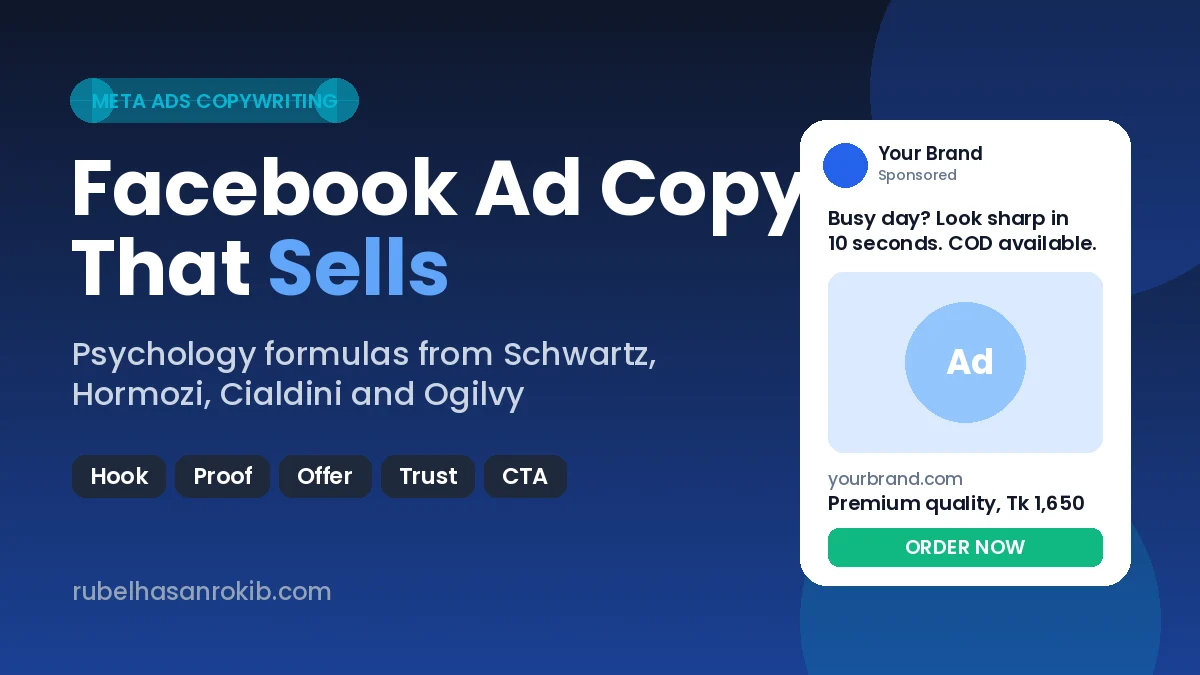
Two ads can use the same video, the same budget and the same audience, and one brings sales at half the cost of the other. In most accounts I manage, the difference is the words: the first line people read, the headline under the video and the way the price is shown.
This guide shows how I write Facebook ad copy that sells, using the psychology published by the most influential copywriters and marketers: Eugene Schwartz, Alex Hormozi, Robert Cialdini, Daniel Kahneman and David Ogilvy. The examples are written for e-commerce brands in Bangladesh, but the principles work in any market.
Quick Answer
Good Facebook ad copy meets buyers at their level of awareness, makes the offer feel valuable and removes the risk of buying. Open with a hook in the buyer’s own words inside the first 125 characters, back it with specific proof, show the price against a higher anchor, reduce risk with cash on delivery, and ask for one clear action. Run at least three different angles per product and let the results pick the winner.
- Put the hook in the first 125 characters.
- Use specific proof, not adjectives.
- Show the value first, then an anchored price.
- Remove risk with cash on delivery or a clear guarantee.
- Ask for one action only.
In This Guide
- Quick Answer
- Why Most Facebook Ad Copy Fails
- Match the 5 Levels of Awareness
- Make the Offer Feel Valuable
- Use Persuasion Principles Honestly
- The 5-Part Ad Copy Formula
- 10 Hooks That Work
- Headlines and Descriptions
- Ad Copy by Business Type
- Facebook vs TikTok vs Google vs Snapchat
- Before and After: A Real Rewrite
- Mistakes to Avoid
- FAQ
Why Most Facebook Ad Copy Fails
Most ads I audit fail for one of three reasons. They talk about the brand instead of the buyer. They lean on empty words like “premium” and “best quality” with nothing to prove them. Or they hide the one thing a buyer needs to decide, usually the price or how delivery works.
Meta now relies heavily on creative to find buyers, so your copy is part of your targeting. The words attract some people and filter out others. Vague copy brings cheap clicks from people who never buy. Clear copy brings fewer, better clicks. Good copy works best inside a clean account setup, which I explain in Facebook Ads campaign structure.
Match the 5 Levels of Awareness
In Breakthrough Advertising, Eugene Schwartz showed that buyers move through five levels of awareness, and copy must start where the buyer is, not where you want them to be. Speak to the wrong level and your cost per purchase climbs.
| Level | What the buyer knows | Where your copy starts | Example |
|---|---|---|---|
| 1. Unaware | Does not see a problem yet | A familiar feeling or situation | “Eyes feel heavy after a full day on your phone?” |
| 2. Problem aware | Feels the problem, knows no solution | The pain in their words, then hope | “Snoring keeping the whole family awake?” |
| 3. Solution aware | Knows solutions exist, not yours | Why your product is different | “Not regular cotton: soft silk that needs no ironing” |
| 4. Product aware | Has seen your product, not convinced | Proof, objections, risk reversal | “Check it at the door, then pay” |
| 5. Most aware | Ready to buy | Price and offer, straight away | “Was Tk 1,900, now Tk 1,650” |
A simple rule: use level 1 to 3 hooks for cold, broad audiences, and level 4 to 5 copy for retargeting. Someone who added to cart yesterday does not need the story again. They need the price, the offer and a reason to finish the order. I cover audiences and windows in detail in my guide to Meta Ads management.
Make the Offer Feel Valuable
Alex Hormozi’s value equation from $100M Offers explains why people pay: value equals the dream outcome multiplied by the perceived likelihood of getting it, divided by the time delay and the effort required. Most ads only describe the dream. The bigger wins usually come from showing that the result is likely, fast and easy.
| Driver | How to show it in copy | Example |
|---|---|---|
| Dream outcome (increase) | How the buyer will feel, and how others will see them | “Everyone at the office will ask where you got it” |
| Likelihood (increase) | Real video, exact specs, genuine reviews, cash on delivery | “What you see in the video is what arrives” |
| Time delay (decrease) | How fast they get it or see the result | “Fast delivery inside Dhaka” (only if true) |
| Effort (decrease) | How easy it is to use | “No ironing. Put it on and go” |
Use Persuasion Principles Honestly
Robert Cialdini identified seven principles that drive people to say yes: reciprocity, commitment, social proof, authority, liking, scarcity and unity. They work because they are mental shortcuts. They also backfire fast when faked, because fake scarcity and fake reviews destroy trust and get ads rejected.
| Principle | Honest use in an ad | Avoid |
|---|---|---|
| Social proof | Real reviews, real order counts, customer photos with permission | Invented reviews or numbers |
| Scarcity | Real deadlines or genuinely limited stock | Fake countdowns, “only 2 left” when untrue |
| Authority | Real certificates, years of experience, qualified experts | Fake doctors or borrowed celebrity names |
| Reciprocity | Free size guide, usage tips, free advice first | Gifts with hidden conditions |
| Liking | Write like a friend, in the buyer’s language | Corporate or robotic tone |
| Commitment | A small first step, like “call to check your size” | Pushy multi-step pressure |
| Unity | “Made for working women like us” | Divisive group targeting |
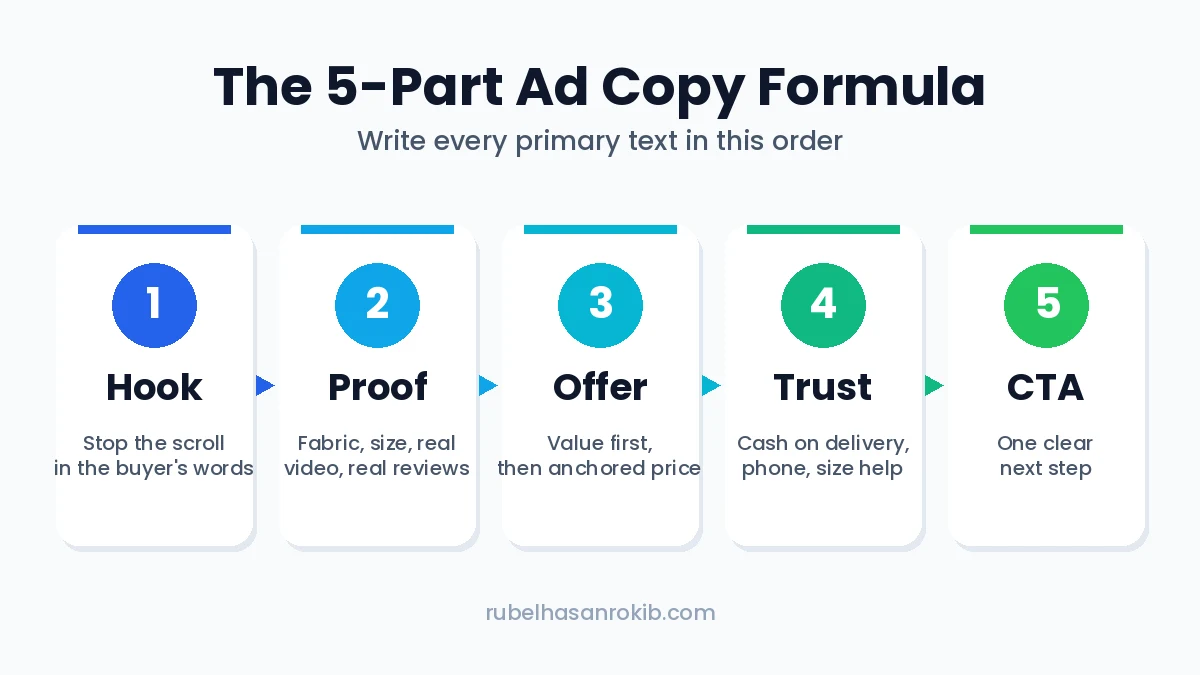
The 5-Part Ad Copy Formula
Every primary text I write follows the same order. Meta cuts primary text after roughly 125 characters on many placements, so the hook and the main benefit must sit above the “See more” link.
- Hook: stop the scroll with the buyer’s problem, desire or a question, in their own words.
- Proof: fabric, size, ingredients, quantity, real video or real reviews. Specific facts, not adjectives.
- Offer: value first, then the price against a higher anchor.
- Trust: remove the risk with cash on delivery, a phone number or size help.
- Call to action: one clear next step, such as “Tap below and choose your size”.
Example for a women’s three-piece: “Everyone at the office will ask where you got it. Black soft silk three-piece, now Tk 1,650. Soft, light fabric that needs no ironing. Full set: kameez 44″, dupatta 90″, pant 40″. Sizes 36 to 50. Was Tk 1,900. Cash on delivery all over Bangladesh. Tap below to pick your size.”
10 Hooks That Work
The hook decides whether anyone reads the rest. I test at least three different hook types for every new product.
| Hook type | Why it works | Example |
|---|---|---|
| Problem question | Buyers recognise themselves | “Bought a dress online that looked nothing like the photo?” |
| Dream or status | Desire for admiration | “Walk in and everyone asks where you got it” |
| Price surprise | Anchoring | “The Tk 1,900 three-piece, now Tk 1,650” |
| Specific number | Specifics build belief | “100 glow stones for Tk 390” |
| Identity | Shared identity (unity) | “For mums whose kids outgrow clothes in two months” |
| Myth buster | Curiosity | “Expensive does not always mean durable” |
| Before and after | Shows the change | A real customer’s result, with permission |
| Gift angle | Occasion and love | “A gift your father will use every single day” |
| Seasonal deadline | Loss aversion | “Winter sowing season ends soon” (when true) |
| Social proof | Following others | “120 orders this week” (real numbers only) |
For video ads, put the same hook as on-screen text in the first three seconds. Many people watch with the sound off.
Headlines and Descriptions
David Ogilvy’s most quoted lesson is that far more people read the headline than the body copy. On Facebook the headline is the bold line under the image or video, and it often decides the click.
- Use the product name plus the biggest benefit or the price, around 40 characters.
- Strong: “Black soft silk three-piece, now Tk 1,650”. Weak: “Cash on delivery all over Bangladesh”, because it does not even name the product.
- Keep the description for secondary information. Facebook Feed often hides it on single image and video ads.
- Match the headline to the landing page. If the ad says Tk 1,650, the product page must say Tk 1,650.
Ad Copy by Business Type
The same formula applies everywhere, but the hook and the proof change with what people are really buying.
| Business | What buyers really buy | Best hook | Proof to show | Main objection |
|---|---|---|---|---|
| Fashion and three-piece | How they will look and what others will say | Status, occasion (office, dawat, Eid) | Real video, fabric, measurements | “Will it look like the photo?” |
| Health and supplements | Relief from discomfort | Problem question (PAS) | Ingredients, usage, genuine reviews | “Will it work?” Use honest, verifiable claims only |
| Seeds and agriculture | Yield and income | Before and after, sowing season | Variety name, growing guide | “Will it grow?” |
| Gadgets and home | Convenience or a wow moment | Demo, specific numbers | Usage video, quantity | “Is it cheap quality?” |
| Wallets and accessories | Style or a gift | Gift angle, old wallet problem | Close-up of leather and stitching | “Is it real leather?” |
| Kidswear | Comfort and a cute look | Parent identity | Size by age, fabric | “Will the size fit?” |
| Services and leads | A trusted professional | Problem plus fast solution | Past work, licences, reviews | “Can I trust them?” |
Facebook vs TikTok vs Google vs Snapchat
The offer stays the same across platforms, but the buyer’s mindset does not, so the hook and the length change.
| Platform | Buyer mindset | Copy style |
|---|---|---|
| Facebook and Instagram | Scrolling, not shopping | Hook, short story, offer. First 125 characters matter most |
| TikTok | Wants entertainment | Short, spoken, creator style. The message lives in the first 1 to 2 seconds of video. See my TikTok Ads in Bangladesh guide |
| Google Search | Actively searching | Keyword in the headline, price, offer, trust signals. 30 character headlines, 90 character descriptions |
| Snapchat | Young and fast | Very short, visual first, 34 character headline |
Before and After: A Real Rewrite
Here is a pattern I fixed recently on a women’s fashion account. The original ad had a strong video but almost no copy:
Before: “Elegant and stylish premium look. Digital printed dress for office or university. Cash on delivery all over Bangladesh.” Headline: “Cash on delivery all over Bangladesh”. The link went to a category page, not the product.
The ad got engagement, but Meta rated its quality below average, and buyers had to search for the dress and its price after clicking. I rewrote it into three angles and sent each to the exact product page:
- Price anchor: fabric, measurements, sizes, then “Was Tk 1,900, now Tk 1,650”.
- Identity: “Everyone at the office will ask where you got it.”
- Objection handling: “Bought a dress online that looked nothing like the photo? Check it at the door, then pay.”
Meta now decides which angle wins with real data, and the losers get paused after three to four days. The landing page matters just as much, so read 5 landing page changes that lift conversions before you scale.
Mistakes to Avoid
- Health claims you cannot prove, such as “cures glaucoma” or “100% guaranteed results”. They break Meta’s policies.
- Fake reviews, invented order counts, false “stock almost gone” messages or fake countdown timers.
- Using a real doctor’s or celebrity’s name or photo without permission.
- Copy that points at personal attributes, like “Are you overweight?”. Meta does not allow it.
- A price in the ad that differs from the price on the website.
- Sending traffic to a category page when the ad shows one product.
- Running one version of copy and never testing another angle.
FAQ
What makes Facebook ad copy convert?
A clear hook in the buyer’s words, specific proof, an anchored price, a way to remove risk such as cash on delivery, and one call to action.
How long should Facebook ad copy be?
Put the hook and main benefit in the first 125 characters. The rest can be longer if it adds proof and answers objections.
Should I show the price in my Facebook ad?
For most products in the Tk 1,000 to 3,000 range, yes. It filters out people who cannot buy and usually lowers cost per purchase. For high-ticket items, test it.
How many ad copy variations should I test?
At least three different angles per product, such as desire, objection handling and price, then keep the winner and write new versions of it.
Does ad copy affect Facebook ad costs?
Yes. Copy changes who clicks, your conversion rate and Meta’s quality ranking, and all three affect cost per purchase.
Final Thoughts
Great ad copy is not clever wording. It is the buyer’s problem, specific proof, a fair price and no risk, said in the buyer’s language. Write three angles, let Meta test them, and keep writing new versions of whatever wins. Accurate tracking makes those tests reliable, so make sure your Meta Conversion API is set up correctly.
Further Reading
- Meta Ads guide
- Meta Business Help Center
- Levels of Awareness (Eugene Schwartz), The Personal MBA
- The Value Equation (Alex Hormozi), explained
Need ad copy that actually sells?
I am Rubel Hasan Rokib, a data-driven digital marketer based in Bangladesh. Send me your product link or ad account details on WhatsApp and I will reply with a clear plan.