
A landing page can make or break your marketing campaign. You might have compelling ads, a great product, and steady traffic, but if your landing page doesn’t convert visitors into customers, you’re leaving revenue on the table.
The good news is that improving conversion rates doesn’t always require a complete redesign. In many cases, a handful of strategic changes can significantly increase leads, sales, and overall return on ad spend (ROAS).
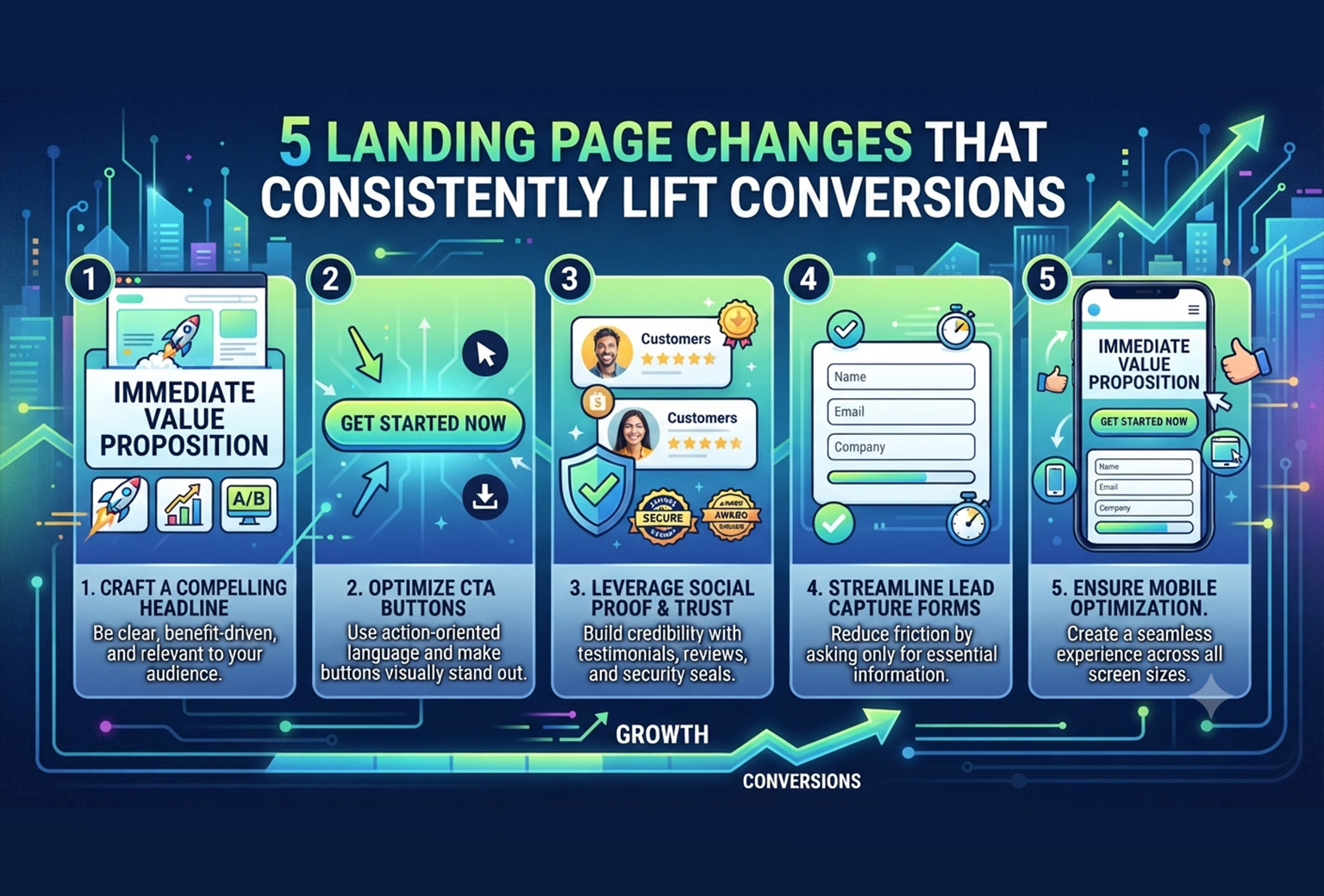
In this guide, we’ll explore five proven landing page improvements that consistently help businesses increase conversions.
In This Guide
- Why Landing Page Optimization Matters
- 1. Improve Your Headline and Value Proposition
- 2. Simplify Your Call-to-Action (CTA)
- 3. Build Trust with Social Proof
- 4. Reduce Form Friction
- 5. Improve Page Speed
- Bonus Tips That Can Further Increase Conversions
- Measure Your Results
- Common Landing Page Mistakes
- Final Thoughts
Why Landing Page Optimization Matters
Every visitor who lands on your page has already shown interest by clicking your ad, email, or search result. Your landing page’s job is simple: guide them toward taking the desired action.
Whether your goal is to generate leads, sell products, or encourage bookings, even small improvements in user experience can lead to measurable increases in conversion rates.
Benefits of optimizing your landing page include:
- Higher conversion rates
- Lower cost per acquisition (CPA)
- Better user experience
- Improved ad performance
- Higher return on advertising spend (ROAS)
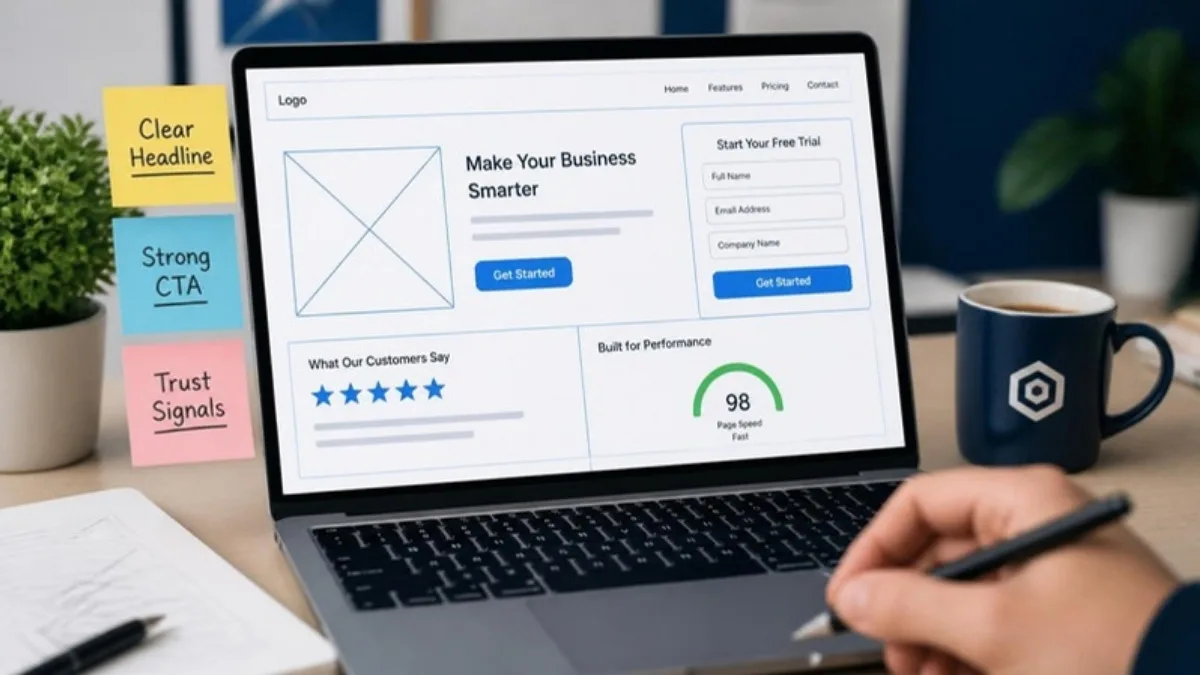
1. Improve Your Headline and Value Proposition
Your headline is the first thing visitors notice. Within a few seconds, they decide whether your page is relevant.
A weak or generic headline often causes users to leave immediately.
Poor Example
Welcome to Our Website
Better Example
Increase Your Facebook Ad ROAS with Accurate Server-Side Tracking
An effective headline should clearly answer:
- What are you offering?
- Who is it for?
- Why should someone care?
Best Practices
- Focus on the main benefit.
- Keep it short and easy to understand.
- Match the message from your advertisement.
- Support it with a clear subheadline.
2. Simplify Your Call-to-Action (CTA)
Many landing pages overwhelm visitors with too many choices.
Avoid placing multiple competing actions such as:
- Learn More
- Contact Us
- Subscribe
- Shop Now
- Read Blog
Instead, focus on one primary conversion goal.
Strong CTA Examples
- Get Your Free Audit
- Book a Free Consultation
- Download the Guide
- Start Your Free Trial
- Buy Now
CTA Best Practices
- Use action-oriented language.
- Make buttons large and easy to find.
- Place CTAs above the fold and throughout longer pages.
- Use contrasting colors to make buttons stand out.
3. Build Trust with Social Proof
Visitors are more likely to take action when they see that others have already trusted your business.
Adding credibility elements can significantly reduce hesitation.
Effective Trust Signals
- Customer reviews
- Testimonials
- Case studies
- Before-and-after results
- Client logos
- Industry certifications
- Security badges
- Money-back guarantees
Example
Instead of saying:
We are experts.
Show:
Trusted by 500+ businesses with an average rating of 4.9/5.
Real evidence is always more persuasive than self-promotion.
4. Reduce Form Friction
Long forms often discourage users from completing your conversion goal.
Ask only for the information you truly need.
High-Friction Form
- Full Name
- Company
- Job Title
- Phone
- Address
- Country
- Industry
- Budget
- Website
Better Version
- Name
- Phone (if necessary)
You can always collect additional details later.
Form Optimization Tips
- Remove unnecessary fields.
- Enable autofill where possible.
- Display validation errors instantly.
- Optimize forms for mobile users.
- Clearly explain why you’re asking for information.
5. Improve Page Speed
Speed has a direct impact on user experience and conversions.
If your page takes too long to load, visitors may leave before seeing your offer.
Common causes of slow landing pages include:
- Large images
- Unoptimized JavaScript
- Excessive third-party scripts
- Poor hosting
- Unused CSS
Ways to Improve Speed
- Compress images.
- Use modern image formats like WebP.
- Minify CSS and JavaScript.
- Enable browser caching.
- Use a Content Delivery Network (CDN).
- Implement lazy loading for images below the fold.
A faster landing page not only improves user satisfaction but can also enhance ad quality scores and search performance.
Bonus Tips That Can Further Increase Conversions
Beyond the five core improvements, consider these additional strategies:
- Match landing page messaging with your ads.
- Use high-quality product or service images.
- Add FAQ sections to address common objections.
- Highlight key benefits instead of just features.
- Remove unnecessary navigation links.
- Use whitespace to improve readability.
- Ensure the page is fully responsive on mobile devices.
- Test different CTA button text and placements.
- Use urgency or scarcity ethically, such as limited-time offers or limited stock.
- Continuously run A/B tests to validate improvements.
Measure Your Results
Optimization is an ongoing process. Track your landing page performance using analytics tools to understand what works and where users drop off.
Useful tools include:
- Google Analytics 4 (GA4)
- Google Tag Manager (GTM)
- Microsoft Clarity
- Meta Pixel
- Meta Conversion API
- Google Ads Conversion Tracking
Monitor metrics such as:
- Conversion Rate
- Bounce Rate
- Engagement Rate
- Average Engagement Time
- Cost Per Conversion
- Revenue Per Visitor
Data-driven decisions consistently outperform guesswork.
Common Landing Page Mistakes
Avoid these common issues:
- Slow loading times
- Weak headlines
- Too many CTAs
- Cluttered layouts
- Poor mobile experience
- Long forms
- Missing trust signals
- Low-quality visuals
- Unclear value proposition
- Inconsistent messaging between ads and landing pages
Fixing even one of these issues can improve your conversion rate.
Final Thoughts
High-converting landing pages are built through continuous testing and refinement, not one-time design efforts. Small improvements, such as strengthening your headline, simplifying your call-to-action, adding trust signals, shortening forms, and improving page speed, can produce meaningful gains in conversions over time.
Whether you’re running Google Ads, Meta Ads, email campaigns, or organic marketing, an optimized landing page helps you get more value from every visitor. Start by implementing these five changes, measure the results, and continue testing. Consistent optimization is the key to long-term conversion growth.
Official Resources
Need help with your landing page?
I am Rubel Hasan Rokib, a data-driven digital marketer based in Bangladesh. Send me your website or ad account details on WhatsApp and I will reply with a clear plan.