
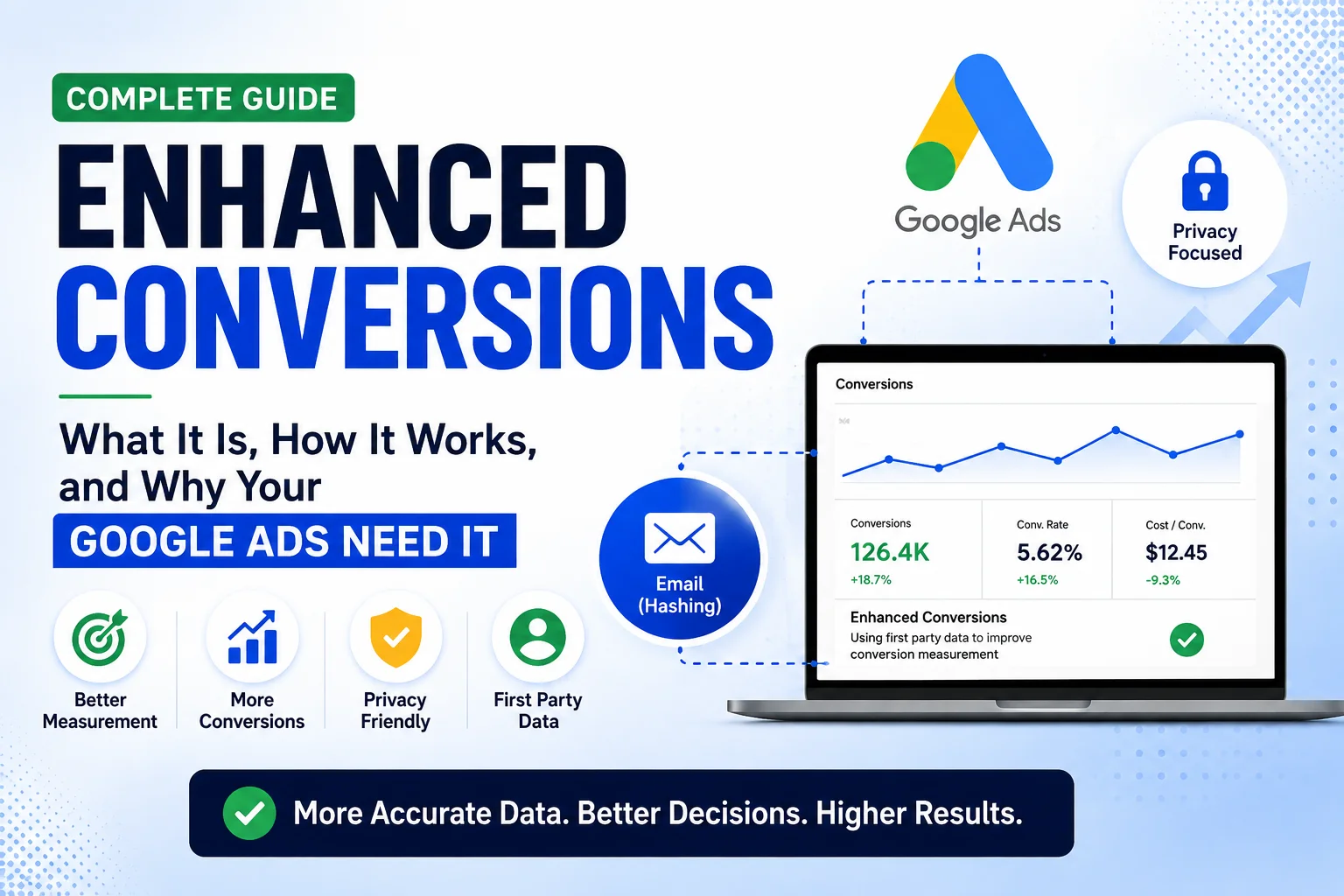
Running Google Ads is not only about getting clicks.
The real question is what happens after someone clicks your ad.
Did they purchase something? Did they submit a form? Did they call your business? Did they become a customer?
This is where enhanced conversions can make a meaningful difference.
As digital advertising becomes more privacy focused, measuring every customer action is becoming more challenging. Browser restrictions, privacy settings and changes in tracking technology can create gaps between what actually happens on a website and what an advertising platform can measure.
Enhanced conversions is one of Google’s solutions for improving conversion measurement by using consented first party customer information in a privacy focused way.
In simple terms, it can help Google Ads understand more of the conversions that happen on your website.
In This Guide
- What Are Enhanced Conversions?
- Why Do Enhanced Conversions Matter?
- How Do Enhanced Conversions Work?
- Enhanced Conversions and First Party Data
- Enhanced Conversions and Privacy
- Enhanced Conversions for Web
- Enhanced Conversions for Leads
- Enhanced Conversions vs Traditional Conversion Tracking
- Enhanced Conversions With Google Tag Manager
- Enhanced Conversions and Google Ads
- Enhanced Conversions and Smart Bidding
- Common Enhanced Conversions Mistakes
- Enhanced Conversions for E-commerce
- Enhanced Conversions for Lead Generation
- Enhanced Conversions Is Part of a Bigger Tracking Strategy
- How Enhanced Conversions Fits With Meta Conversion API
- How I Approach Enhanced Conversions
- Does Every Business Need Enhanced Conversions?
- When Should You Implement Enhanced Conversions?
- Final Thoughts
- Need Help With Google Ads Tracking?
What Are Enhanced Conversions?
Enhanced conversions is a Google Ads feature designed to improve the accuracy of conversion measurement.
When someone completes an important action on your website, the website may already have first party information provided by that customer, such as an email address or phone number.
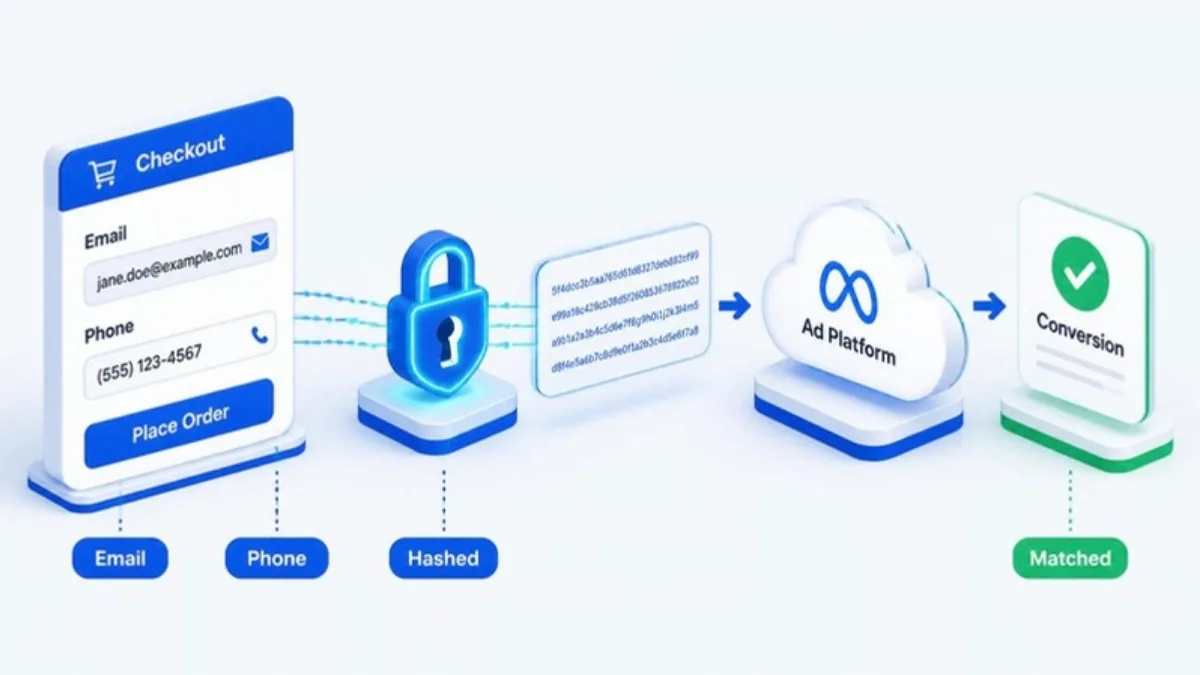
With enhanced conversions, eligible customer information can be normalized and hashed using SHA 256 before being securely sent to Google. Google can then use the hashed information to help match conversions and improve measurement.
The important thing to understand is that enhanced conversions does not replace your existing conversion tracking.
Instead, it works as an additional signal alongside your existing conversion setup.
Why Do Enhanced Conversions Matter?
Imagine you are running Google Ads for an online store.
Your Google Ads account reports 80 purchases, but your actual store records 100 orders.
You now have a measurement gap.
Which number should you trust?
There can be many technical reasons why some conversions are not observed or attributed in the same way.
Browser restrictions, privacy settings and other measurement limitations can affect conversion reporting.
This is where enhanced conversions can become useful.
By using additional first party conversion information, businesses can provide Google with stronger signals for understanding customer actions.
Better conversion data can also give automated bidding systems more useful information when optimizing campaigns.
But there is one important point:
Enhanced conversions is not a magic button that makes an unprofitable campaign profitable.
Your offer, keywords, advertisements, landing page, audience, website experience and overall marketing strategy still matter.
Enhanced conversions simply helps improve the measurement foundation.
How Do Enhanced Conversions Work?
Let’s look at a simple example.
A person searches Google for a service.
They see your advertisement and click it.
They visit your website and submit a contact form.
The website now has information provided by the customer, such as an email address.
Your conversion tracking system records the lead.
The relevant first party information can then be normalized and hashed before being sent to Google as part of the enhanced conversions setup.
The simplified customer journey looks like this:
Google Search → Ad Click → Website → Lead or Purchase → First Party Data → Hashing → Google → Conversion Measurement
The process happens in the background.
The customer does not need to manually do anything extra.
Enhanced Conversions and First Party Data
First party data is an important part of enhanced conversions.
First party data means information that a customer provides directly to your business through interactions with your website or other business channels.
For example:
• Email address
• Phone number
• Name
• Address information
Depending on the implementation and conversion type, relevant customer information can be used as part of the measurement process.
The purpose is not to give advertisers access to personal customer information.
Instead, the information is handled in a hashed format for matching and measurement.
Businesses still need to follow applicable privacy laws, consent requirements and Google’s customer data policies.
Enhanced Conversions and Privacy
Privacy is one of the most important considerations when implementing any modern tracking system.
Enhanced conversions uses hashing to protect customer information during the measurement process.
However, hashing does not mean businesses can ignore privacy responsibilities.
You should always consider:
• How customer information is collected
• Whether appropriate consent is required
• How customer information is stored
• How information is transmitted
• Whether the implementation follows Google’s policies
• Whether local privacy requirements apply
Good tracking is not simply about collecting more data.
It is about collecting and using the right data responsibly.
Enhanced Conversions for Web
There are different ways businesses can use enhanced conversions.
Enhanced conversions for web is designed for conversions that happen directly on a website.
For example, an e-commerce customer may follow this journey:
Product View → Add to Cart → Checkout → Purchase
Or a service business might have:
Google Ad → Landing Page → Contact Form → Lead
Enhanced conversions can supplement the existing Google Ads conversion tracking for these types of website conversions.
This can be especially useful when accurate conversion measurement is important for campaign optimization.
Enhanced Conversions for Leads
Lead generation businesses have a slightly different challenge.
A website form submission may not be the final business outcome.
For example:
Google Ad → Website → Lead Form → Sales Call → Customer
The person who submits the form may eventually become a paying customer days or weeks later.
In this situation, enhanced conversions for leads can help businesses connect online lead information with later offline customer outcomes.
This can be particularly valuable for businesses with longer sales cycles.
Examples include:
• Real estate
• B2B services
• Consulting
• Education
• Professional services
• High-ticket services
For these businesses, simply counting website leads may not tell the complete story.
The real goal is often qualified leads and actual customers.
Enhanced Conversions vs Traditional Conversion Tracking
Traditional conversion tracking remains important.
You still need to define the actions that matter to your business and configure the appropriate conversion events.
Enhanced conversions works alongside this system.
Think about it this way:
Conversion Tracking = What action happened?
Enhanced Conversions = Additional first party signals that can help Google measure that action more effectively.
So, enhanced conversions should be viewed as an improvement to your measurement setup rather than a replacement for conversion tracking.
If you want to understand the fundamentals of conversion measurement, read my Conversion Tracking Guide before implementing enhanced conversions.
Read the Conversion Tracking Guide
Enhanced Conversions With Google Tag Manager
Google Tag Manager is commonly used to implement and manage website tracking.
Instead of manually placing multiple tracking codes throughout a website, businesses can use Google Tag Manager to manage tags and triggers from one central system.
For enhanced conversions, the implementation needs to be planned carefully.
You need to understand:
• Which conversion action you are tracking
• Where the conversion happens
• What first party customer information is available
• How the information should be collected
• How the data should be handled
• Whether the conversion event fires correctly
• Whether Google receives the expected data
A technically working tag does not automatically mean that your tracking strategy is correct.
The business goal should come first.
Enhanced Conversions and Google Ads
Conversion data plays a major role in performance marketing.
Suppose you are running three Google Ads campaigns.
Campaign A generates many clicks.
Campaign B generates fewer clicks but more leads.
Campaign C generates fewer leads but those leads have a much higher closing rate.
If you only look at clicks, Campaign A may appear to be the winner.
If you have accurate conversion and customer data, you can make a much more informed decision.
This is why measurement matters.
The goal of tracking is not to collect impressive numbers. The goal is to understand which marketing activities are producing real business results.
Enhanced Conversions and Smart Bidding
Google Ads uses conversion signals to help automated bidding systems make decisions.
When Google receives better quality conversion information, it can have more useful data to work with when optimizing campaigns.
This is one reason enhanced conversions can be valuable for advertisers using automated bidding strategies.
However, advertisers should not assume that simply enabling enhanced conversions will automatically improve performance.
The underlying conversion actions must be meaningful.
If you tell Google that every page view is a conversion, you may provide the system with a large amount of data but very little useful business information.
Quality of conversion data matters more than quantity.
Common Enhanced Conversions Mistakes
There are several mistakes I frequently see when businesses work on conversion tracking.
1. Installing It Without Fixing Existing Tracking
If your existing Google Ads conversion tracking is broken, enhanced conversions will not magically solve the problem.
The foundation needs to be correct first.
2. Tracking the Wrong Conversion
Not every website interaction should be treated as a primary conversion.
A product purchase and a simple page view have completely different business values.
3. Incorrect Customer Data
Enhanced conversions depends on relevant first party information being available at the appropriate conversion point.
If the data is missing or incorrectly configured, the measurement may not work as expected.
4. Ignoring Event Configuration
Your conversion event, parameters and tracking setup need to match the actual customer journey.
5. Not Testing the Implementation
After implementing enhanced conversions, testing is essential.
You should verify that:
• The conversion fires correctly
• The expected information is available
• The tag or tracking setup works correctly
• Google receives the conversion data
• There are no unnecessary duplicate conversions
6. Ignoring Privacy Requirements
Technical tracking should always be considered alongside privacy and consent requirements.
Enhanced Conversions for E-commerce
E-commerce businesses are one of the areas where accurate conversion measurement can make a major difference.
Imagine an online store spending $1,000 on Google Ads.
The store generates 50 purchases.
But which campaigns produced those purchases?
Which keywords generated the highest-value customers?
Which advertisements generated the best return?
Without accurate conversion tracking, answering these questions becomes much harder.
With a properly structured measurement system, businesses can make decisions based on actual customer actions rather than clicks alone.
Enhanced Conversions for Lead Generation
The same principle applies to lead generation.
Suppose a service business receives 200 leads from Google Ads.
That number sounds impressive.
But if only 10 of those leads become customers, the business needs to understand why.
Now imagine another campaign generates only 80 leads but produces 20 customers.
The second campaign may be far more valuable.
This is why tracking should move beyond simple lead volume.
The quality of the conversion matters.
Enhanced Conversions Is Part of a Bigger Tracking Strategy
One mistake businesses make is treating every tracking technology as a separate solution.
In reality, a strong measurement setup usually involves multiple components working together.
For example:
Google Ads Conversion Tracking
Enhanced Conversions
Google Tag Manager
GA4
Consent Management
First Party Data
Each component has a different role.
The goal is not to install as many tracking technologies as possible.
The goal is to create a measurement system that accurately represents the important actions happening on your website.
How Enhanced Conversions Fits With Meta Conversion API
If your business runs both Google Ads and Meta Ads, you may already be working with server-side tracking solutions.
Meta Conversion API is designed to send conversion events from your server to Meta.
Enhanced conversions serves a different purpose within the Google Ads ecosystem.
Both are part of the broader shift toward stronger first party measurement and more resilient conversion tracking.
If you are also running Meta Ads, you can read my detailed guide:
Meta Conversion API Guide: What It Is and Why It Matters
Understanding both technologies can help businesses build a more complete measurement strategy across their advertising platforms.
How I Approach Enhanced Conversions
When I work on conversion tracking, I do not start by asking where to paste a tracking code.
I start with the business objective.
First, I identify what actually counts as a conversion.
Then I map the customer journey.
After that, I review the existing Google Ads conversion tracking and website setup.
Only then do I determine how enhanced conversions should fit into the overall tracking system.
The technical implementation may involve Google Tag Manager, the Google tag or another appropriate solution depending on the website and business requirements.
Finally, everything needs to be tested.
Because good tracking is not just about making a tag fire.
Good tracking starts with a good measurement strategy.
Does Every Business Need Enhanced Conversions?
Not every website has the same requirements.
However, if your business relies heavily on Google Ads and your primary goal is generating measurable sales or leads, enhanced conversions is worth considering.
It can be particularly relevant for:
• E-commerce businesses
• Lead generation websites
• Service businesses
• B2B companies
• Local businesses
• Businesses with longer sales cycles
• Businesses investing significantly in Google Ads
The more important conversion measurement is to your advertising strategy, the more valuable a reliable tracking setup becomes.
When Should You Implement Enhanced Conversions?
If your Google Ads campaigns are already generating conversions and you want to improve the quality of your measurement, this can be a good time to evaluate enhanced conversions.
Before implementation, however, make sure the basics are working.
Your:
Website tracking
Google Ads conversion actions
Google Tag Manager setup
Conversion events
Customer journey
should all make sense first.
Then enhanced conversions can become another layer of your measurement strategy.
Final Thoughts
Enhanced conversions is not just another Google Ads setting.
For businesses that depend on accurate conversion measurement, it can become an important part of their advertising infrastructure.
As the digital advertising environment becomes more privacy focused, advertisers need better ways to understand what happens after a user interacts with an advertisement.
Enhanced conversions can provide additional first party conversion signals that help strengthen this measurement process.
But the technology itself is only one part of the equation.
The most important thing is to understand what you are measuring, why you are measuring it and how that information connects to your actual business goals.
Better tracking does not guarantee better marketing. But better tracking gives you better information, and better information helps you make better marketing decisions.
Need Help With Google Ads Tracking?
If you need help with Google Ads conversion tracking, enhanced conversions, Google Tag Manager, GA4 or other digital marketing tracking solutions, you can learn more about my services.
Explore Google Ads and Digital Marketing Services
I’m Rubel Hasan Rokib, a Digital Marketing Specialist focused on performance marketing, advertising, analytics and conversion tracking.
My approach is simple:
Track accurately. Understand the data. Optimize based on evidence.
Official Resources
Need help with Google Ads Enhanced Conversions?
I am Rubel Hasan Rokib, a data-driven digital marketer based in Bangladesh. Send me your website or ad account details on WhatsApp and I will reply with a clear plan.